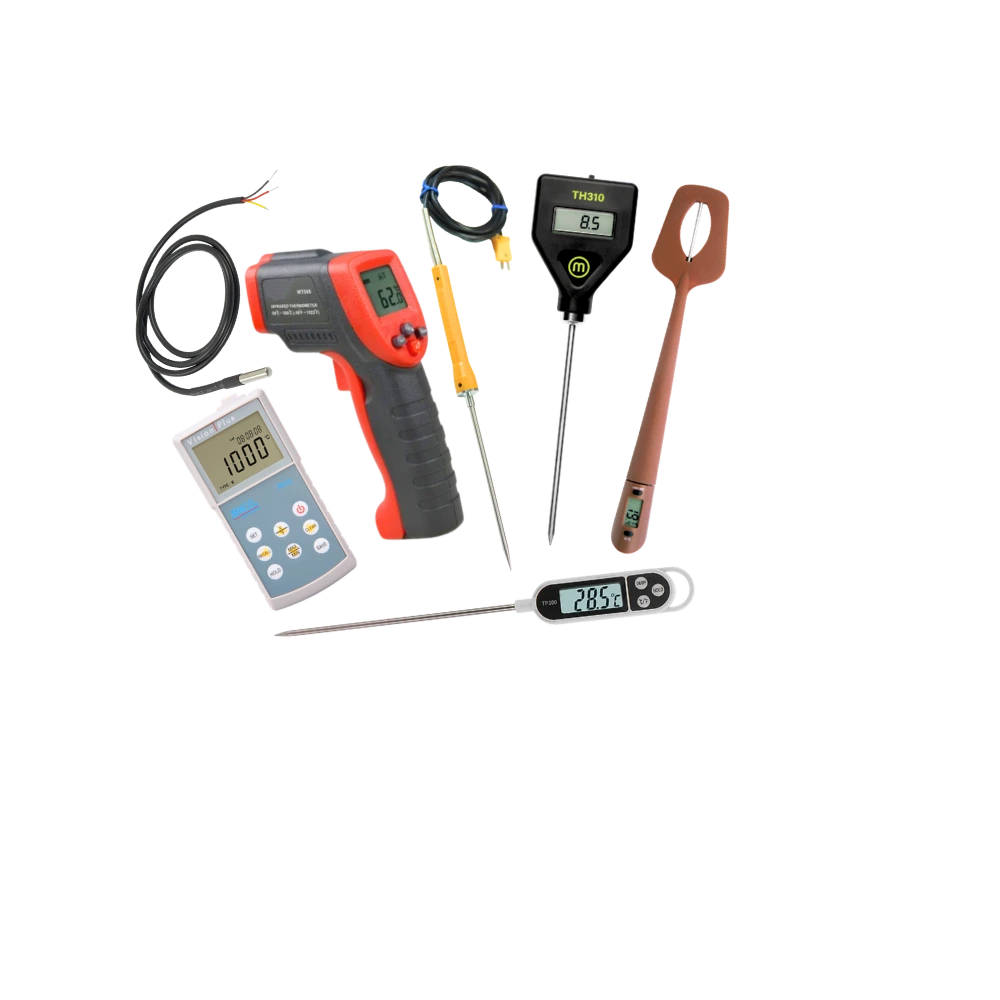
Thermometers & Temperature Probes

A Thermometer is a device used to measure temperature in various applications, including medical, industrial, and culinary settings. They are rugged, precise instruments designed for demanding industrial environments.  They come in both contact (probe) and non-contact (infrared) types, each suited for specific applications and safety requirements.

Key Features to Consider

  • Temperature Range: Ensure the thermometer and its compatible probes cover the full range of temperatures you need to measure.
  • Accuracy and Resolution: Industrial applications often require high accuracy (e.g., ±0.1°C) and resolution (e.g., 0.1°C).
  • Durability and IP Rating: Look for rugged, splash/dust-resistant housing (IP ratings like IP65 or IP67) for use in harsh industrial environments.
  • Data Logging and Connectivity: Features like data logging, internal memory, and connectivity (USB, Bluetooth, Wi-Fi) allow for recording measurements over time and exporting data for analysis.
  • Probe Type/Compatibility: Many handheld units are compatible with various interchangeable probes (Type K, J, T, E, N, R, S thermocouples, or RTD/Pt100 sensors), allowing one device to be used for multiple tasks.


Temperature Probes

Temperature probes are sensors—including thermocouples, thermistors, and Pt100 RTDs—designed for precise, rapid measurement of air, liquid, or surface temperatures in industrial and commercial applications. Constructed from robust materials like stainless steel, these devices generate voltage or resistance signals that connect to data loggers or displays.

Key Types and Applications

    • Thermocouples (e.g., Type K & Type T): Fast-response, durable, and suitable for wide temperature ranges, often used in harsh, high-temperature environments.

Thermocouples, specifically Type K (Chromel-Alumel) and Type T (Copper-Constantan), are common temperature sensors using Seebeck effect voltage, with Type K (−200°C to 1260°C) offering a wide, general-purpose range and Type T (−200° C to + 350°C) providing superior accuracy and stability in cryogenic or moist environments. Type K is the most common industrial sensor, while Type T is preferred for low-temperature accuracy.

    • RTDs (Resistance Temperature Detectors, e.g., Pt100): Highly accurate and stable, ideal for precise industrial, food, and pharmaceutical applications.  (RTDs), such as the common Pt100, are highly accurate, stable sensors that measure temperature by correlating it with increased electrical resistance in a metal element, typically platinum. A Pt100 has a resistance of 100Ω at 0∘C  and generally operates between-50∘C and +250∘ (up to 850∘C for specialized types). They are preferred for precision, repeatability, and linearity in industrial and laboratory applications.
    • Thermistor Probes (NTC):Sensitive, and quick-acting,  ideal for HVAC, automotive engines, and industrial processes.

NTC (Negative Temperature Coefficient) thermistor probes are highly accurate, cost-effective sensors that decrease in resistance as temperature rises, commonly used for temperature measurement and control between -50°C and +150°C. They are ideal for HVAC, automotive engines, consumer appliances, and industrial processes due to their rapid response times, compact size, and durable, often stainless steel, housing.

info@spraytech.co.za
(541) 754-3010
1236, Melville Road, Los Angeles, CA 67890
Visit our FacebookVisit our InstagramVisit our Twitter
Contact Us
Copyright © Soflyy
Proudly designed with Oxygen, the world's best visual website design software
phone-handset linkedin facebook pinterest youtube rss twitter instagram facebook-blank rss-blank linkedin-blank pinterest youtube twitter instagram